
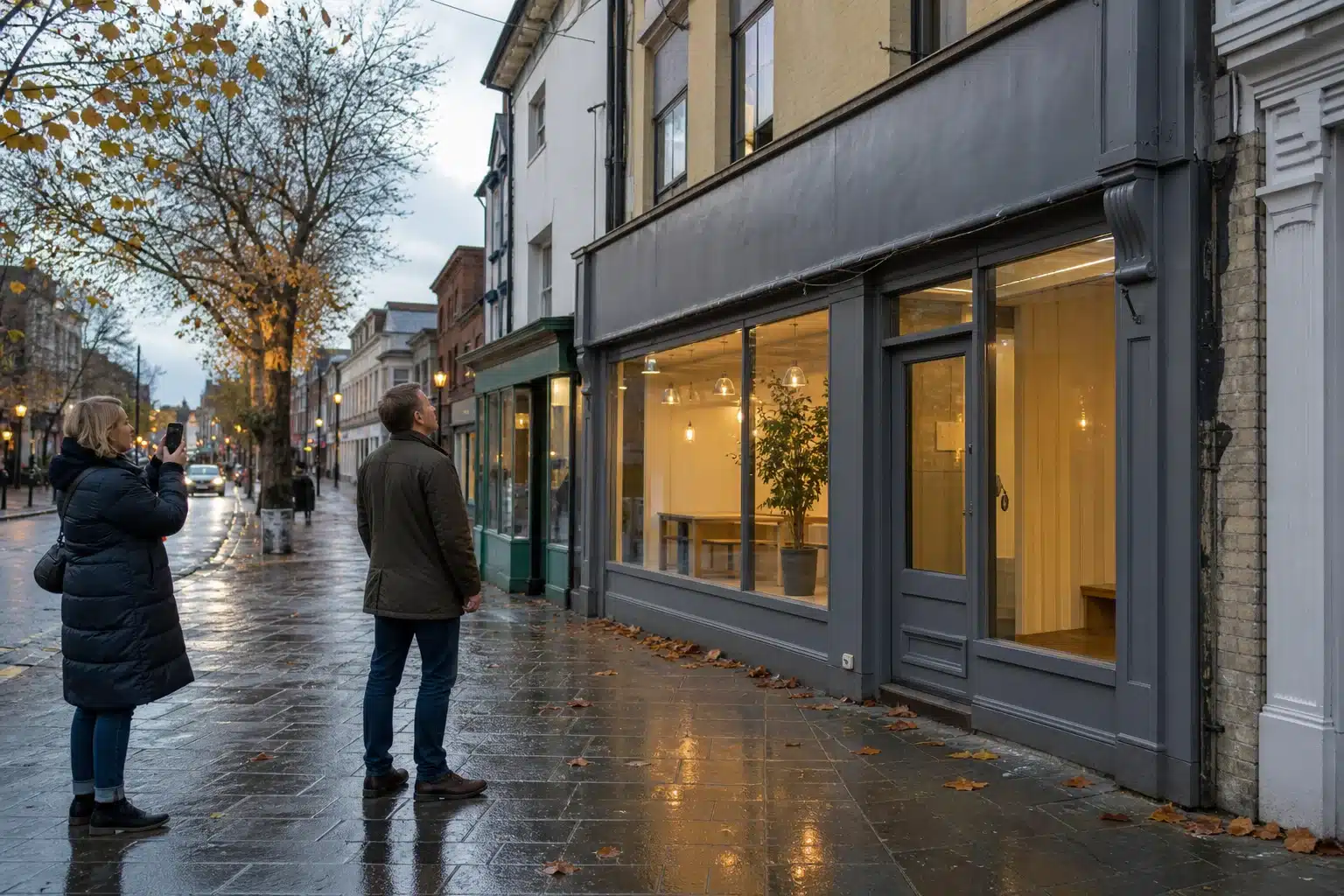
When planning shop signs in Norwich, check how clearly someone can identify your business from the pavement after dark—not just how the design looks on a screen. Shorter winter days make contrast, viewing distance and lighting more important. Before ordering a new sign, visit the site at the times customers are likely to arrive and note what they can actually see.
Start across the road, then approach along each pavement customers might use. Can you read the business name without stopping? Is the entrance obvious? A sign that looks prominent from directly outside may be hidden by a projecting building, street furniture or another shopfront from farther away.
Repeat the check in daylight and after dusk. Take photographs from roughly eye level, but use them as a reminder rather than a substitute for looking in person: a phone camera can make a dim scene appear brighter than it feels. Note any nearby lights that create glare or draw attention away from your sign.
If several messages compete for space, decide which one matters most. Usually, people need to recognise the business and find the entrance before they can absorb smaller details. A simple hierarchy—name first, supporting information second—will often work harder than filling every available area.
Letter size depends on viewing distance and how quickly people pass. Stand where your intended audience will first see the sign and ask whether the main words are easy to distinguish. Fine type, tightly spaced lettering and long lines are harder to read at a glance, particularly in rain or low light.
Contrast matters as much as colour choice. Dark lettering on a light background, or light lettering on a dark background, can help the key message stand out. Check physical samples where possible: colours on a backlit screen may not represent how a finished material will look outside. A glossy finish can also produce distracting reflections under some lighting.
Illumination is worth considering if visibility during darker hours is important, but it is not the only answer. Existing street lighting, neighbouring signs, the building frontage and the direction people approach all affect the result. Ask a sign maker to explain suitable options for your site rather than choosing a lit sign from a photograph alone. If you are weighing up types of exterior building signs, include an evening photograph with your enquiry.
A visibility check is also a chance to look for maintenance issues. From a safe position, check whether panels appear secure and level, whether lettering is peeling or faded, and whether dirt is obscuring the design. Do not climb or attempt to inspect electrical components yourself; arrange an appropriate professional assessment if something appears loose or damaged.
Look at the whole frontage, not only the main fascia. Window displays can block sightlines to a sign, while an unclear door graphic may leave visitors unsure which entrance to use. If you are planning a refresh, take measurements and photographs of the fascia, windows and nearby obstructions. Record where the sign must be readable from and whether access for fitting might be restricted.
For a new or replacement sign, ask about materials and finishes suited to the proposed location, along with how the sign will be fitted. Exposure to wind and rain, mounting surface and access can all influence the specification. If permission may be needed for changes to the frontage or illumination, check the requirements for your premises before committing to a design.
A clear brief helps a sign maker recommend an appropriate solution. Include your address, photographs taken by day and after dark, approximate dimensions, the wording you need and any existing brand artwork. Explain whether the priority is recognition from the road, helping pedestrians find the entrance, or both.
Also mention your preferred materials or finish if you have one, but leave room for alternatives. Ask what affects the quote, including sign size, material, illumination and fitting access. For shop and building signs, request clarity on the site survey, design proof and fitting before work proceeds. You can explore shop and building signs while gathering ideas, and use signage design as a supporting starting point if the artwork needs attention.
No. Whether it helps depends on when people need to find you, the light already available and how the sign is positioned. Check visibility at the relevant time before deciding.
Not necessarily. First check whether dirt, poor contrast, glare or an obstruction is the main problem. That assessment will make any discussion about repair, redesign or replacement more useful.
Send frontage photographs from several approaches, approximate dimensions, required wording and any relevant access details. Evening photographs are especially helpful if after-dark visibility is your concern.
If you are reviewing a shop sign in Norfolk or Suffolk, Broadland Digital is a signage company working from offices and workshops in Norwich. To discuss the site and your requirements, contact Broadland Digital or call 01603 407786.