What people mean by Chapter 8.
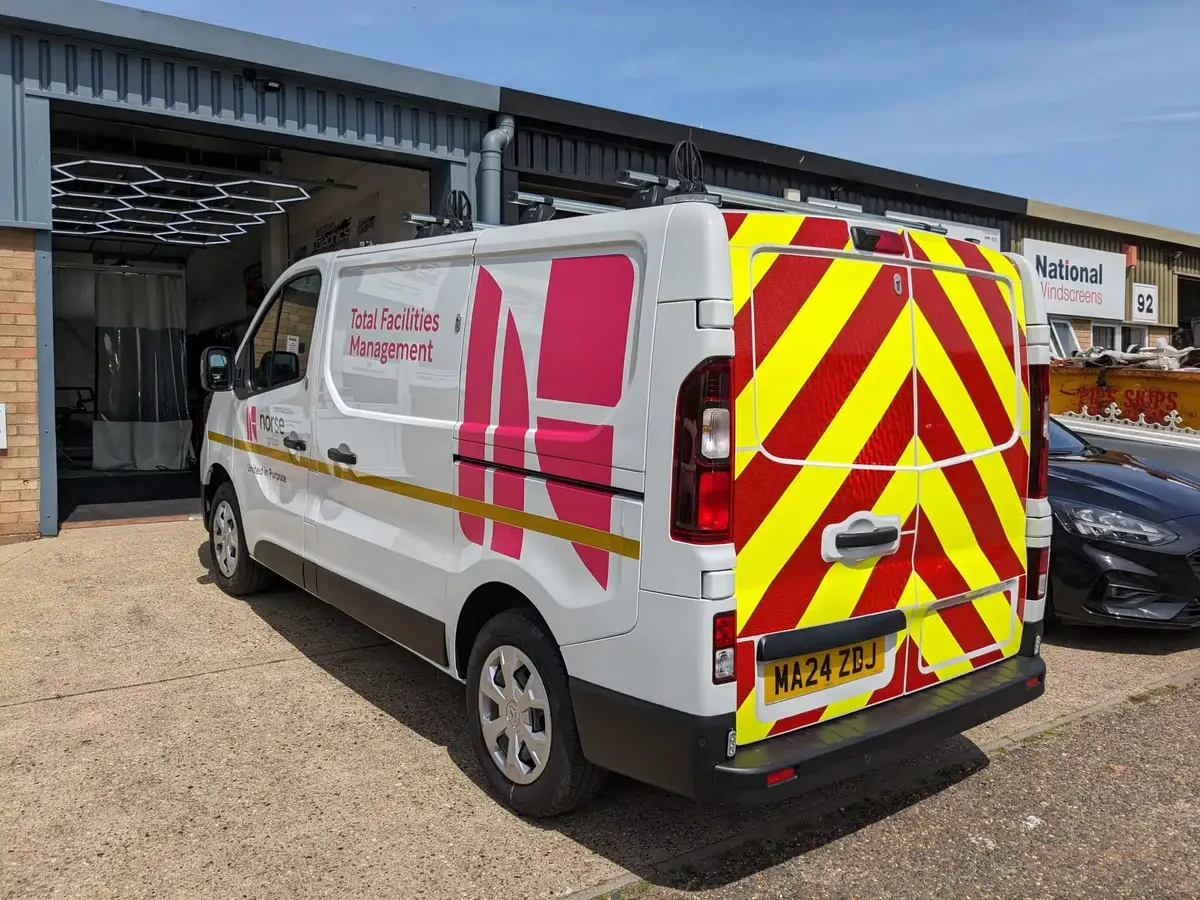
Chapter 8 refers to a chapter of the Traffic Signs Manual, published by the Department for Transport, that deals with traffic safety measures for road works and temporary situations. Among other things, it gives guidance on making vehicles that work on or beside the road more visible to approaching traffic. In everyday use, “Chapter 8 chevrons” means the rear-facing pattern of alternating red and fluorescent yellow retroreflective stripes seen on the back of many highways, utility and works vehicles.
This page is a practical introduction, not a statement of what the guidance requires for your vehicles. The guidance is revised from time to time, and whether it applies depends on the work you do and where you do it. Always check the current version of the guidance and your client’s requirements before ordering.
Who usually asks for chevrons.
Rear chevrons are commonly seen on vehicles that stop, park or work on the highway: road maintenance and highways contractors, utility companies, local authority fleets, traffic management firms and some recovery and survey operators. Smaller trades may come across the requirement when they take on work for a highways client or a larger contractor.
Often the requirement arrives through a contract, a framework or a client’s own vehicle standard rather than from the guidance alone. Those documents can be more specific than the general guidance, setting out the material grade, the area to be covered or extra markings. If you have been asked to fit chevrons, ask the person who asked for a copy of the written requirement. Our page on highways and utilities vehicle graphics covers fleet identification and high-visibility livery for these operators.
Check the guidance and your client’s specification.
Do not rely on copying the van parked next to yours. Another operator’s vehicle may have been fitted to an older version of the guidance, a different client standard or no standard at all. Before you order, find out which version of the guidance applies, whether your client specifies a particular material or class of reflective film, and what coverage of the rear is expected.
Bring that information to us with your enquiry. We can make chevrons to suit the vehicle, but it is your responsibility, and that of your client, to confirm what is required for the work. If the specification is unclear, ask the client to confirm it in writing before the kit is cut. That avoids paying twice for a kit that does not meet the brief.
Pre-cut kits for mainstream vehicles.
We offer Chapter 8 reflective kits for the majority of mainstream vehicles. We keep up-to-date databases of vehicle outlines, so a kit can be cut to the shape of your rear doors, working around handles, hinges, windows, lights and the number plate area. A pre-cut kit saves time on fitting and gives a consistent result across several vehicles of the same model.
To match a kit to your vehicle, we need the make, model, year, roof height and rear door configuration. Twin rear doors, a tailgate, a tipper body and a box body all need different layouts. A photograph of the rear of the vehicle is the quickest way to confirm we are working from the right outline.
Bespoke chevrons for unusual bodies.
Not every vehicle is in a database. Conversions, flatbeds, tippers, box bodies, trailers and specialist equipment often need bespoke chevrons. We produce bespoke cut reflectives using our in-house drag-knife and laser cutters, which allows accurate shapes in reflective materials.
For a bespoke job, send clear photographs of the rear of the vehicle taken square-on, plus measurements of each flat area you want covered. Mark anything that must stay clear, such as lights, reflectors, the number plate, camera lenses, handles and hinges. If the body has a tail lift or a drop-down tailgate, tell us, because the chevrons need to work with the vehicle in its normal driving position.
Fitting: at our workshop or by you.
If you are close to Norwich, you can bring the vehicle to our workshop for fitting. If you are further away, you can ask for a quote for on-site fitting, or we can post a kit for you to fit yourself in your own yard.
If you fit a kit yourself, work on a clean, dry, grease-free surface in mild conditions. Fit one panel at a time, line each section up against a fixed reference such as the door edge, and press the film down firmly from the centre outwards. Do not cover lights, reflectors, the number plate or the rear windows. Cut at door shuts rather than bridging them, so doors open without lifting the film.
Plan chevrons alongside your livery.
Chevrons usually take up most of the rear of a van, which is often where the company name, phone number and web address would go. Plan both together. Contact details can move to the side panels or sit on a band above or below the chevrons if the guidance and your client allow. Our van graphics team can lay out the livery and the chevrons as one design.
Side markings and other conspicuity features are a separate question from rear chevrons. If you are unsure what your vehicles need on the sides, check the guidance and your client’s standard rather than assuming the rear kit covers everything. Chevrons do not replace beacons, lighting or any other equipment your work requires.
Keep reflectives clean and intact.
Reflective film only works when light can reach it. Road dirt, salt and mud on the rear doors reduce how well chevrons show up in headlights, so include the rear of the vehicle in regular washing. Avoid abrasive pads and harsh solvents, which can damage the reflective surface.
Check chevrons as part of routine vehicle checks. Look for damaged, faded or missing sections, especially around door handles and lower edges where loading and reversing take their toll. Keep a note of the vehicle details and kit reference so a replacement panel can be ordered quickly when needed.
Your project checklist.
- Make, model, year, roof height and rear door configuration of each vehicle.
- A square-on photograph of the rear of each vehicle type.
- Your client’s written specification, if you have one.
- Measurements and photos for any bespoke body, trailer or conversion.
- Whether you want workshop fitting, a quote for on-site fitting or a posted kit.
- How many vehicles, and whether livery should be designed at the same time.
Your questions. Answered.
Are Chapter 8 chevrons a legal requirement for my van?
That depends on the work you do and where you do it. We cannot advise on whether they are required for your work. Check the current guidance and your client’s requirements, and ask your client to confirm the specification in writing.
Can you post a chevron kit for me to fit myself?
Yes. If you are not local, we can supply kits by post for self-installation. Fit them on a clean, dry surface and keep lights, the number plate and windows clear.
My vehicle is not a standard van. Can you still make chevrons?
Yes. We produce bespoke cut reflectives with our drag-knife and laser cutters. Send square-on photographs and measurements of the areas to be covered.
Can my company logo go on the rear doors as well?
Plan the rear layout with the chevrons first. Contact details often move to the sides. Check the guidance and your client’s standard before placing anything else on the chevron area.
Do chevrons replace beacons or lights?
No. Rear chevrons are one part of making a vehicle conspicuous. Lighting, beacons and other equipment are separate requirements to check with your client and the guidance.
Sources & further reading.
This guide explains Chapter 8 chevrons in general terms and is not legal advice. Reviewed 3 November 2026. Check the current Traffic Signs Manual Chapter 8 guidance from the Department for Transport and your client’s specification before ordering.
Put the advice into practice.
Send us the vehicle details and your client’s specification. Our Norwich team can supply a kit, make bespoke chevrons or plan them with your livery.
Visit our Norwich workshop ↗ · Find vehicle graphics for your trade ↗