Begin with the risk assessment, not a sign bundle.
There is no single shopping list that makes every workplace safe. The signs for a warehouse, café, school and repair workshop follow the activities and risks at each site. HSE guidance on safety signs and signals explains that signs are needed where significant risks remain after other relevant measures have been taken. A warning board does not replace controlling the hazard. The legal framework is the Health and Safety (Safety Signs and Signals) Regulations 1996, as amended.
Ask the person responsible for workplace safety for the current assessment and any agreed action plan. Turn each signage action into a clear entry: what needs communicating, who needs to see it and where the decision is made. This gives the sign supplier something concrete to produce and prevents a generic pack from becoming a substitute for a considered site arrangement.
Understand the different message families.
HSE’s safety-sign examples distinguish prohibition, warning and mandatory signs. In broad terms, red circular prohibition signs restrict behaviour, yellow triangular warnings identify hazards and blue circular mandatory signs specify actions. These conventions are functional: choosing your brand colour instead can change how a message is understood.
Emergency escape and first-aid signs use green, while firefighting equipment identification uses red. The detailed HSE L64 guidance explains these families and their use. Keep the recognised symbol at the centre of the message, with suitable supporting wording where needed. A decorative recreation should not be approved simply because its wording sounds correct.
Build a location-based sign schedule.
Create a spreadsheet or marked-up floor plan with a unique reference for every sign. Include the message, quantity, proposed position, viewing direction and material requirements. Add a photograph showing the intended fixing surface. The same instruction may be needed at more than one entrance to a controlled area, while several different notices may compete for attention at a single doorway.
Use practical location names such as loading-bay pedestrian entrance or first-floor east corridor. Avoid vague entries such as workshop sign, especially where more than one person will install or check the work. A clear schedule helps the responsible manager approve the arrangement, the supplier price it and the fitter place the right item in the right location.
Coordinate fire signs with the fire assessment.
Fire safety has its own assessment and responsibilities. Government fire-risk-assessment guidance explains that the responsible person must assess and review the premises, keep a written record and consider matters including escape routes, equipment, information and training. Use the resulting fire-sign requirements when preparing the order; a general sign catalogue cannot determine the escape strategy.
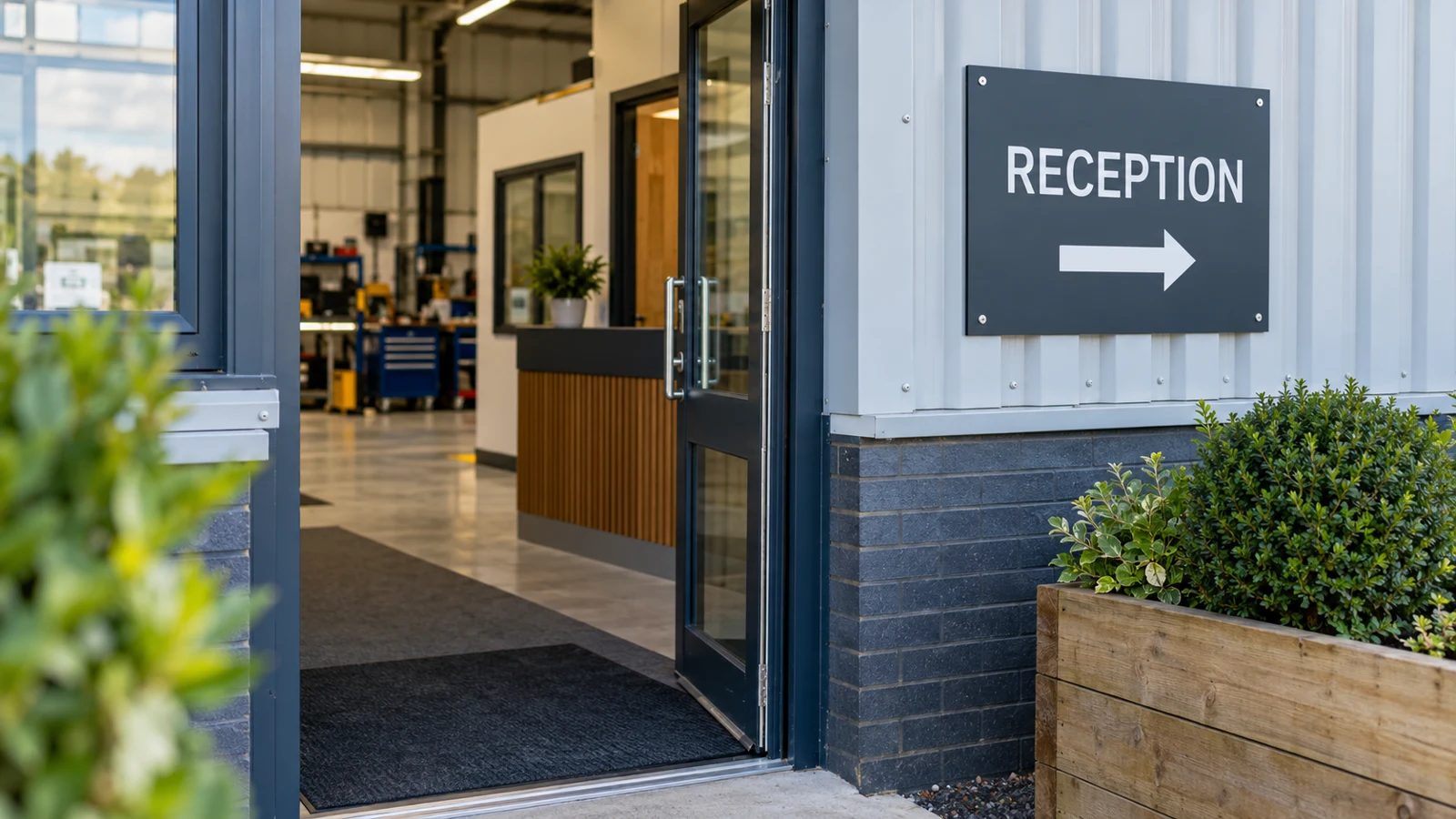
Keep escape-route references separate from ordinary visitor wayfinding on the plan. A sign directing someone to reception serves a different purpose from one identifying an escape route. Ask the responsible person or competent fire adviser to approve messages, arrows and locations before manufacture. If walls, doors or equipment have moved, update the plan first rather than automatically reproducing the previous set.
Check where people will actually read the signs.
Stand at each approach and note the distance and angle from which the message first needs to be understood. Include visitors arriving for the first time, delivery drivers and people entering from secondary doors. Record obstructions such as open doors, shelving, parked vehicles or stored materials. A photograph taken from directly in front of the fixing position does not show all these conditions.
HSE’s L64 guidance on signboards calls for clear signs suited to viewing distance, adequate illumination, durable construction and secure fixing. It also warns against confusing clusters of signs. Use that information to discuss size and location with the responsible person. Enlarging a board may be less useful than moving it to the point where someone chooses a route.
Match the construction to the environment.
Tell the supplier whether the sign is indoors, exposed to weather, regularly washed down or likely to be knocked by equipment. Include information about the surface: painted wall, glass, metal cladding, mesh fence or uneven masonry. Material and fixing choices should follow these conditions. A self-adhesive label and a rigid board can carry the same artwork while requiring very different installation preparation.
For cleaning areas, provide the cleaning method and any products that may contact the sign. For external locations, explain exposure and accessibility for maintenance. If a specialist performance specification applies, supply it rather than relying on a generic description such as heavy duty. Ask the quotation to identify the proposed construction so replacements can be ordered consistently.
Include deliveries and changing work areas.
Map the visitor route, vehicle entrance and delivery handover point as separate journeys. A new driver may need an instruction before entering a yard, while a pedestrian needs information before crossing into a working area. Share the site traffic plan with the person specifying signs. This helps avoid placing a warning after the point at which the intended decision should already have been made.
Temporary work needs an equally clear owner. Record who puts temporary notices out, who checks their position and who removes them when the activity ends. For example, a maintenance project may temporarily change access to a corridor. Its signage should be considered as part of that managed arrangement, rather than leaving an old arrow in place and hoping everyone remembers the verbal instruction.
Example: refreshing signs in a mixed workshop.
Imagine a workshop with a customer reception, vehicle working area and small parts store. The manager reviews the assessment and identifies a need to clarify customer access, equipment-related instructions and first-aid information. A numbered plan records the approved messages. Photographs show that one proposed position would be hidden whenever a roller door is open, so the placement is reconsidered before ordering.
The supplier then quotes the agreed signs by size, material and quantity. The manager checks the proof against the schedule, and the installer records the completed locations. This is an illustrative ordering workflow, not a prescribed safety scheme for every workshop. Its strength is that the assessment determines the requirement and the production process preserves that decision accurately.
Approve content and installation separately.
A good proof approval checks spelling, symbols, arrows, sizes and references. Ask someone familiar with the site to check the content, particularly where similar messages appear in several areas. Avoid approving artwork from a small phone screenshot if the details cannot be read. Record approval against a revision number so an older file cannot accidentally become the production version.
After fitting, walk the site with the approved schedule. Confirm each reference is present and faces the intended approach. Check that nearby notices have not been left pointing elsewhere, and photograph the completed installation. Give the record to the person managing the premises. A tidy handover makes it easier to identify a missing sign during later changes or repairs.
Maintain the information as the workplace changes.
Give the sign schedule an owner and include it in the premises review process. New equipment, altered storage, changed access and relocated first-aid points can make old information unhelpful. Ask staff which notices are hard to see or regularly obscured. Their observations can reveal practical problems that were not apparent during an empty-building survey.
When replacing a damaged sign, check the message is still needed before copying it. Keep the artwork and material reference, but treat the replacement request as an opportunity to confirm the location. Good maintenance is partly physical and partly informational: a pristine board with an outdated instruction still needs attention.
Send an approved schedule for a practical quotation.
Broadland Digital can discuss the production and fitting of the signs identified for your premises. Send the approved schedule, photographs, quantities, sizes and any material or performance requirements. Explain whether the work is a full installation, a phased update or a small replacement order, and tell us how access to the work areas will be managed.
Start with safety and warning signs for workplace messages, fire and emergency signs for the approved fire-sign schedule, or site and safety signs for a wider project. The sign-making brief supports your workplace arrangements; it does not certify the risk assessment or replace competent advice about which controls and signs the premises need.
Your project checklist.
- Use the current workplace assessment and fire assessment.
- Assign a unique reference and location to every required sign.
- Get symbols, messages, arrows and positions approved.
- Record viewing conditions, surfaces and environmental exposure.
- Approve the final proof against the sign schedule.
- Inspect the completed installation and assign responsibility for updates.
Your questions. Answered.
Is a standard safety-sign pack enough?
Only if it happens to match the requirements identified for your premises. Use the assessment and site plan to establish the actual messages, quantities and locations.
Can safety signs use our brand colours?
Recognised safety colours and symbols have a specific purpose. Keep branding separate where it could confuse the safety message, and have the proposed design checked against the required specification.
Who decides where fire-exit signs go?
The arrangement should follow the premises fire assessment and advice of the responsible person or competent adviser. The sign supplier needs that approved schedule to manufacture and install the correct items.
Can you replace a few damaged signs?
Send clear photographs, measurements and any original references. Confirm with the responsible person that the messages and locations remain appropriate before reproducing them.
Sources & further reading.
Sources checked for this draft on 18 October 2026. Product ratings apply to the stated product and test conditions; confirm the current specification for your order.
- HSE: Safety signs and signals overview ↗
- HSE L64: Guidance on the Safety Signs and Signals Regulations ↗
- HSE: Safety-sign examples ↗
- GOV.UK: Fire risk assessments ↗
- Health and Safety (Safety Signs and Signals) Regulations 1996 ↗
This guide concerns England. The relevant authority or responsible project team should confirm the requirements for your premises. Technical production review is required before public launch.
Put the advice into practice.
Tell us where the sign will go, what it needs to communicate and the date you are working towards. Our Norwich team can discuss the design, materials and fitting around your project.
Visit our Norwich workshop ↗ · Find signage for your sector ↗