Start with the job, then choose the board.
A reception panel, a permanent workshop sign and a weekend event arrow can all carry the same printed artwork, but they should not automatically use the same board. The substrate is the physical sheet underneath the graphics. It influences how the sign sits against a wall, how it handles transport, what its edges look like and how it can be fitted. Choosing the most expensive sheet for every application is rarely necessary; choosing the cheapest without considering the installation can also create avoidable replacement work.
Begin with three questions: where will the board go, how will it be supported, and how long will the message remain relevant? A sign with a changing date has a different replacement cycle from your business name. Tell us whether people will inspect it at arm’s length or read it across a yard. We can then compare complete specifications, including print, finish, fittings and installation, rather than judging materials by a sample thickness alone.
Compare at a glance.
On a smaller screen, scroll across to compare all options.
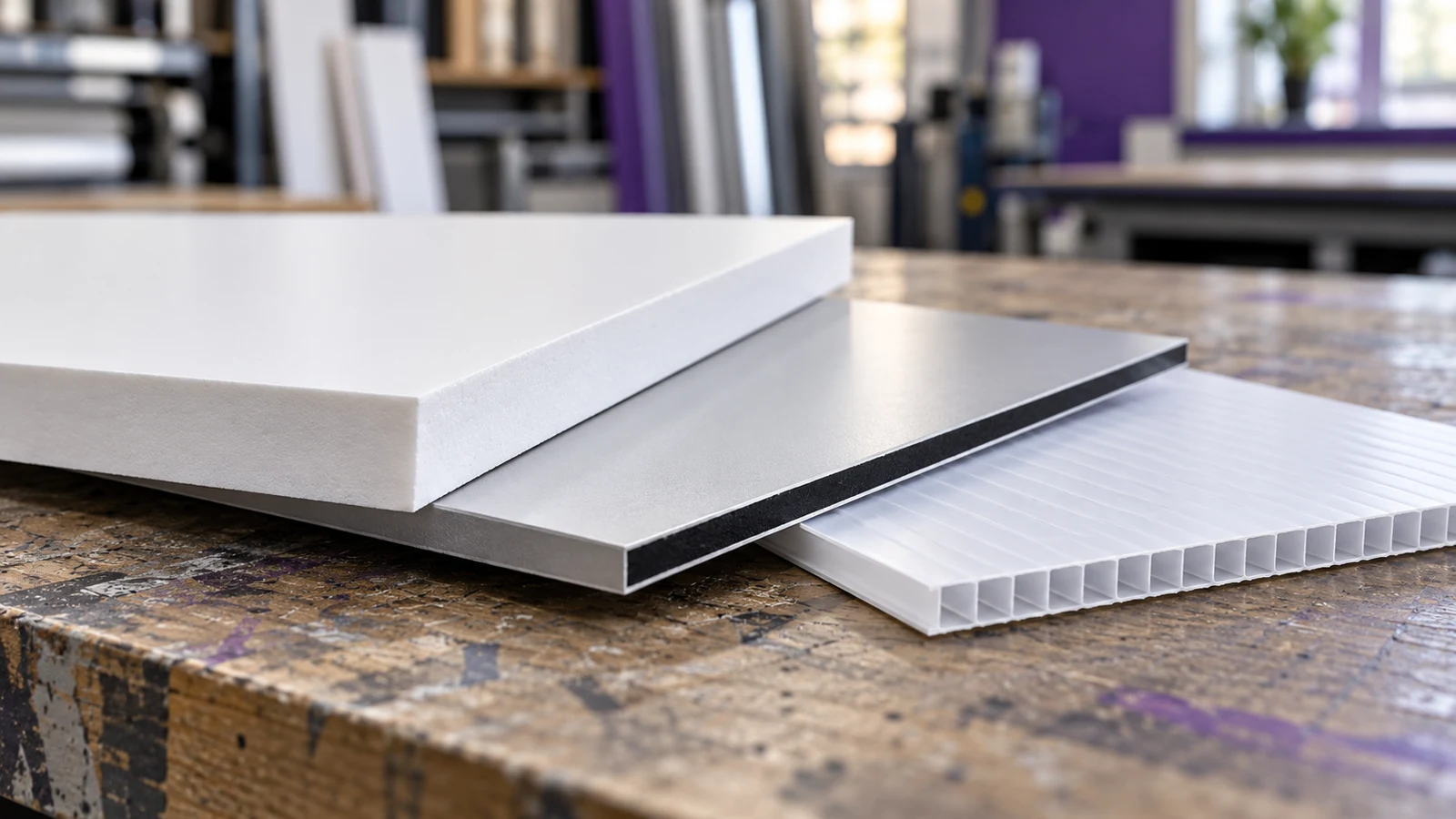
| Factor | Foamex / foam PVC | Aluminium composite | Correx |
|---|---|---|---|
| Typical starting point | Supported indoor graphics | Lasting exterior identity | Temporary campaign boards |
| Construction | Rigid foam PVC sheet | Aluminium skins around a core | Fluted polypropylene sheet |
| Close viewing | Smooth face; inspect exposed edges | Flat face; tidy edge planning matters | Flutes can influence appearance |
| Support | Specify backing and fixings | Specify fixing structure and spacing | Plan ties, holes and frame support |
| Transport | Protect face and corners | Protect against dents and edge damage | Avoid crushing and bending |
| Outdoor selection | Check exact grade and exposure | Check exact grade and installation | Match short-term use and exposure |
| Changing message | Reprint or replace to suit campaign | Consider whether updates justify specification | Useful to consider for frequent replacement |
| Buying priority | Finished appearance and support | Whole installation and long-term brief | Clear message and proportionate specification |
Foamex: useful for smooth, lightweight displays.
Foamex is a name commonly used in UK signage for rigid foam PVC sheet. It is not the paper-faced foamboard used for some presentation mounts. Manufacturer ranges such as 3A Composites FOREX illustrate this material family; the actual brand, grade and thickness should be stated in your quotation.
Consider it for indoor information boards, retail displays and wall-mounted graphics where a smooth printed face matters. A modest panel supported against a suitable wall is a different proposition from a large sheet spanning between posts. The layout of the fixings and the backing can be as important as the nominal thickness. For shaped graphics, discuss the outline and narrow sections before artwork is finished.
Its limitations deserve attention when the board will be outdoors, exposed to heat, knocked during handling or left unsupported. Do not assume all foam PVC is suitable for every external location. Request a grade-specific recommendation and agree how expansion, fixings and exposed edges will be accommodated. If a pristine edge is central to a premium reception installation, compare a physical sample with the alternatives.
Aluminium composite: a strong candidate for lasting exterior branding.
Aluminium composite material, often abbreviated to ACM, combines aluminium outer skins with a core. It is not a solid aluminium plate. DIBOND manufacturer information describes its sheet as rigid and suitable for indoor and outdoor applications. Generic ACM products differ, so the name alone does not establish the exact specification.
For workshop identification, business park panels or a long-term fascia face, ACM is often worth comparing first. Its flat appearance suits clean lettering and broad colour areas. However, a flat sheet still needs an appropriate fixing arrangement. The building substrate, panel dimensions, access and exposure should determine the installation, rather than copying the fixing pattern from an unrelated sign.
The initial material cost may be higher than a temporary board solution, and damaged corners or dents can undermine the finish. Consider protective handling and installation access early. Different cores, coatings and grades are available; do not treat a general signage sheet as a substitute for a specified building or fire-performance product. Where a project has formal performance requirements, obtain the exact product documentation before approval.
Correx: practical when the message is temporary.
Correx is a branded fluted polypropylene sheet manufactured by Corplex. The hollow fluted construction differs visibly from solid-looking foam PVC and aluminium composite. It is useful to consider when the sign needs to be light, easy to distribute and proportionate to a short campaign.
Temporary event directions, changing construction notices and promotional boards are good starting points for discussion. Think about whether the board will be tied to a fence, mounted to a frame or placed into a purpose-made holder. Flute direction, hole positions and the contact area around each fixing affect how the panel behaves; simply pulling cable ties tighter is not a substitute for choosing a suitable fixing arrangement.
Correx is less suited to briefs where a perfectly smooth premium face or a substantial exposed edge is the main goal. A board that performs well for temporary instructions can look out of place as the principal sign on a carefully finished shopfront. It should also not be described as universally recyclable without checking how the printed and fitted finished board will actually be collected locally.
Compare installed signs, not loose sheets.
Ask for the same finished size, artwork coverage and fixing scope in each quotation. One price may include drilled holes and another only the printed board. One may include a site survey, removal of an existing panel and installation; another may be collection only. Separate these items so you can see which difference comes from the material and which comes from the work needed to put it in place.
Photographs should show the entire installation area and a closer view of the mounting surface. Mention brick, render, cladding, fencing or a freestanding frame. Avoid drilling or climbing to gather information: approximate measurements from a safe position are enough for an initial conversation. Final fabrication dimensions and fixing details may need a survey.
Three example briefs, three different priorities.
Illustrative example: a Norwich retailer needs a seasonal offer board inside a window. The message changes frequently, customers stand close to it and the display is supported. A smooth foam PVC board is worth assessing, with attention to sunlight, glare and the chosen holder. There is little value in specifying a heavier permanent installation solely because it sounds more robust.
Illustrative example: an engineering company wants its name above a yard entrance. The artwork is unlikely to change and the sign represents the business every working day. Compare an ACM panel with a properly planned installation. A temporary campaign board might reduce the purchase price but would not necessarily meet the desired appearance or support requirements.
Illustrative example: an organiser needs a set of arrows for a one-day event. Lightweight Correx may suit the temporary message and distribution plan, provided positioning, fixing and removal are agreed. Direction arrows need to be checked individually against the actual route; printing the same arrow on every panel can create confusion on site.
Make the graphic work at its actual viewing distance.
Board choice cannot rescue a crowded design. Give the main message enough space, use clear contrast and decide what can be read from the intended approach. A road-facing panel needs a shorter message than a reception information board. Ask for a proof that shows the finished panel shape and any holes, with essential text clear of the fixing zones.
If several boards form a larger display, agree the panel joins before production. Keep important letters and faces away from awkward seams where possible. Ask how replacement panels would be matched later, especially if a campaign may expand. Retain the approved artwork and specification so a future reorder starts with the correct size and material.
Our practical starting point.
For a smooth supported indoor display, start the discussion with foam PVC. For lasting exterior identity, compare aluminium composite. For temporary directions and short campaigns, consider Correx. These are useful starting points rather than blanket rules. The right recommendation comes from the combination of environment, finished dimensions, mounting and the standard of appearance you want.
Your project checklist.
- Finished width and height, quantity and whether each board differs.
- Indoor or outdoor position, photographs and the intended viewing distance.
- Expected campaign duration and how often the wording changes.
- Mounting surface or frame, access restrictions and existing fixings.
- Single or double-sided artwork, shape and any drilled holes.
- Required collection, delivery or fitting date and a realistic budget range.
Your questions. Answered.
Is thicker always better?
No. Thickness is only one part of the specification. A smaller well-supported panel can behave differently from a larger unsupported one. Compare the exact material and fixing arrangement rather than choosing by thickness alone.
Can I use the same artwork on all three?
Usually the design can be adapted, but the final proof should match the actual panel dimensions, shape and fixing areas. Colours and surface appearance can differ, so request a sample if brand matching is particularly important.
Which lasts longest?
There is no reliable universal lifespan without knowing the product, print system, exposure and installation. Tell us the intended service period and ask for a recommendation based on the complete sign.
Can existing fixings be reused?
Possibly, after their position and condition have been checked. A new panel can have different support needs. Send photographs, but allow for inspection before treating the old installation as suitable.
Sources & further reading.
Sources checked for this draft on 18 October 2026. Product ratings apply to the stated product and test conditions; confirm the current specification for your order.
Put the advice into practice.
Tell us where the sign will go, what it needs to communicate and the date you are working towards. Our Norwich team can discuss the design, materials and fitting around your project.
Visit our Norwich workshop ↗ · Find signage for your sector ↗