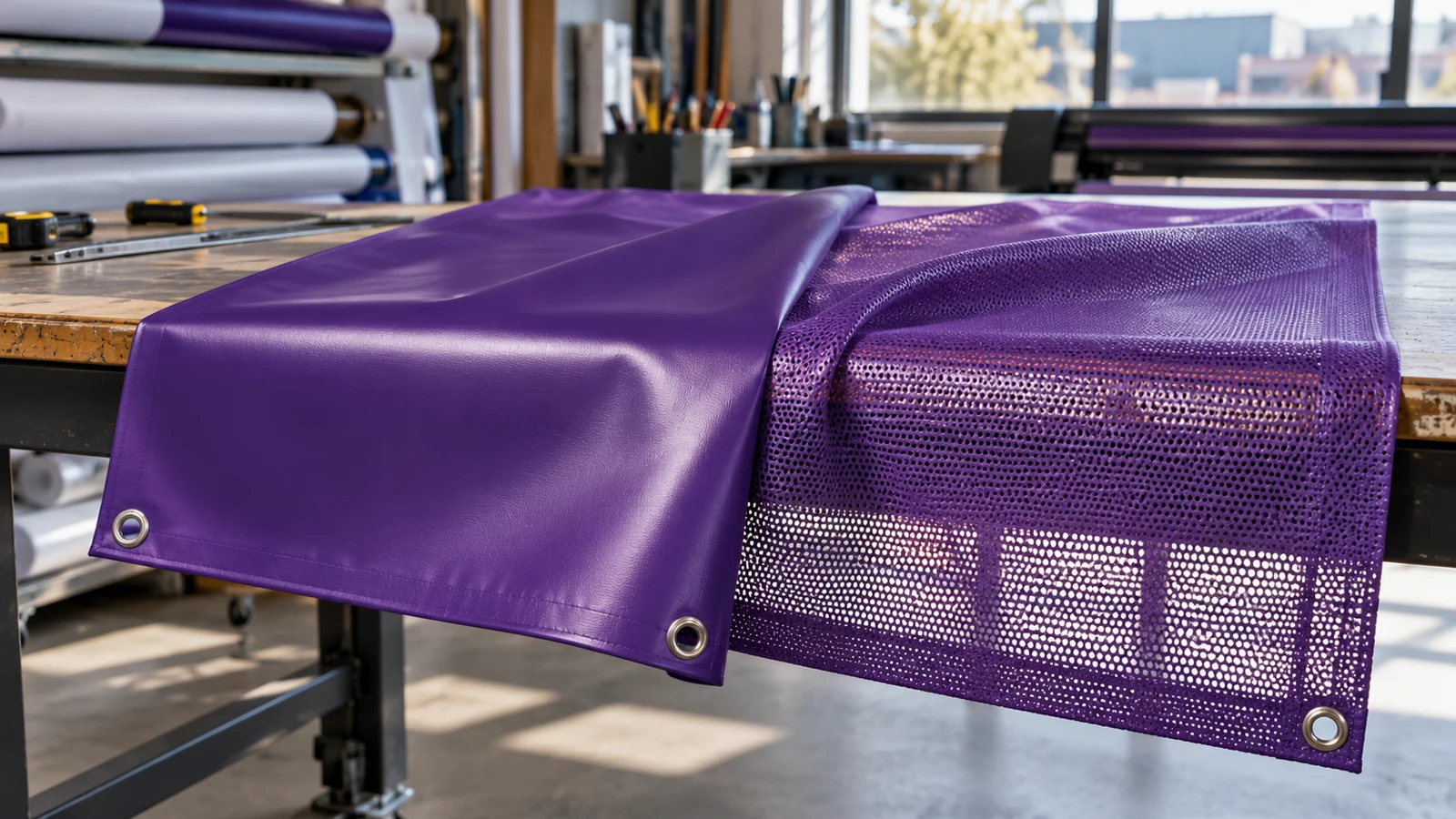
The important difference is solid versus open-weave.
People often ask for PVC or mesh as if these were two completely different material families. In practice, many mesh banners are also PVC-coated. The useful comparison is between a solid printed banner and a perforated or open-weave mesh banner. For example, HEXIS PG450 is described by its manufacturer as a PVC-coated polyester mesh. Always compare the exact products offered rather than relying on the shorthand name.
The choice starts with the installation. A sheltered wall display, an exposed fence and a large scaffold advertisement present very different conditions. Mesh openings can let air pass through, but they do not make the banner windproof or remove the load on its supports. Tell us what the graphic will attach to before deciding the material, finished size or finishing method.
Compare at a glance.
On a smaller screen, scroll across to compare all options.
| Factor | Solid PVC banner | Mesh banner |
|---|---|---|
| Print surface | Continuous face for artwork | Open structure affects appearance |
| Wind exposure | Requires suitable supports and assessment | Openings help air pass; assessment still needed |
| Close-up detail | Useful for fine design where viewing allows | Simplify small text and intricate features |
| Background | Usually more visually continuous | Background can show through openings |
| Privacy | Discuss opacity of exact product | Do not assume privacy or concealment |
| Fixing | Specify hems, eyelets or pockets | Specify compatible reinforcement and fixing |
| Double-sided display | Requires an appropriate product and layout | Do not assume readable artwork on both sides |
| Best starting point | Sheltered promotions and continuous graphics | Selected exposed or large-format applications |
| Structural approval | Needed for the actual support arrangement | Not avoided by choosing mesh |
Solid PVC: give the printed message a continuous background.
A solid banner is useful when you want broad colour, photography or text to sit on an uninterrupted surface. It is a natural option to compare for promotions, event announcements and temporary branding where the position and support suit it. Because the face is continuous, the design does not have to work around the visual effect of open mesh.
Its limitation is also its defining feature: the solid face presents a larger continuous area to moving air. A banner must not be treated as an ordinary poster when it is fixed outdoors. The condition and strength of the structure, the attachment method and the exposure need to be assessed together. A convenient fence is not automatically a suitable structure.
Discuss whether the display needs to be read from one or both sides. Standard front-facing banner construction should not be assumed to provide an effective double-sided graphic. If people approach from opposite directions, a different specification or two separately planned displays may be more appropriate. Tell us whether sunlight or lighting behind the banner could affect the presentation.
Mesh: useful where the openings serve a purpose.
Mesh is worth considering for some exposed outdoor positions and large displays because its open structure allows some air and light through. The amount depends on the actual weave and product specification. Avoid choosing from an unsupported percentage claim: the whole installation still has to be appropriate for the site.
Those openings also remove parts of the printable surface. A graphic can look different against a pale wall, an open yard or a busy background visible through it. Strong shapes, clear text and a restrained message are useful starting points. A tiny address or intricate pattern that looks crisp on screen may not deliver the same result when printed on mesh and viewed at a distance.
Mesh is not a privacy screen simply because it carries artwork. If hiding activity behind a fence is part of the brief, make that requirement explicit. Equally, a banner cannot be assumed to provide a certified containment or safety function. Advertising, screening and protective netting are different requirements and should be specified separately.
Hems, eyelets and pockets need an installation plan.
Finishing determines how the printed sheet connects to its supports. Reinforced edges, eyelets or pole pockets may be appropriate, depending on the product and location. Agree the proposed system before the artwork is signed off so text and logos stay clear of folds, attachment points and any parts hidden by the frame.
Do not choose eyelet spacing simply because it was used on the previous banner. A new size, material or position can change the brief. Ask who is responsible for the supports, who will fit the banner and who will inspect it during use. For temporary events, include a practical plan for removal and storage rather than stopping at the opening date.
A sign on a scaffold or temporary fence requires coordination with the person responsible for that structure. Do not attach advertising without their agreement. The request should include the size, position and proposed material, allowing them to assess the effect on the installation. Mesh should never be presented as automatic approval to cover an otherwise unassessed structure.
Design for the background and approach.
Photograph the site from where the audience will see the banner. A landscape graphic above eye level needs a different composition from a banner beside a queue. Make the business name or event message prominent, then add only the secondary information people genuinely need at that distance. If a web address is included, keep it short and easy to distinguish.
For mesh, review a printed sample when close-up appearance or brand colour is important. Seeing the actual surface is more useful than judging a small digital mock-up. For solid material, consider reflections and the direction of light. Neither choice makes small text readable from far away, and adding more information usually competes with the main message.
Three examples of how the brief changes the choice.
Illustrative example: a café announces an opening event on a sheltered wall close to the entrance. A solid banner may be a good starting point because the graphics include photography and the audience is nearby. The fitting still needs to suit the wall, and the design should leave space for the agreed attachments.
Illustrative example: a contractor wants branding on fencing around a Norfolk site. Mesh may be worth assessing, but the fence owner or responsible contractor must first review the proposed covering and supports. A sequence of smaller signs might suit the information hierarchy better than one large continuous graphic. The choice should follow the site assessment, not replace it.
Illustrative example: an event organiser wants a sponsor backdrop behind speakers indoors. A solid print surface may give cleaner logos, but the system must also fit the venue and its requirements. A banner suspended from an improvised support may be less suitable than a purpose-made display. Start with the available footprint, approved suspension points and presentation photographs.
Check the position before committing to production.
Outdoor advertising may need consent even when it is temporary. England’s government advertisement guidance explains the consent framework and advises contacting the relevant local planning authority when requirements are uncertain. Owner permission is also a separate consideration. Confirm the proposed location and display dates before ordering a finished banner.
For a building wrap or scaffold advertisement, obtain advice on the specific proposal rather than assuming normal small-banner arrangements apply. Supply a photograph and dimensions with your enquiry. We can help organise the signage information, while the relevant authority and people responsible for the site establish the approvals and structural requirements.
Plan handling, inspection and the next campaign.
Agree a safe inspection arrangement appropriate to the display. Look for loose attachments, damaged edges and changes to the supporting structure, following the installer’s instructions. If a banner appears unsafe, keep people clear and involve the responsible installer or site team. Do not climb or attempt repairs without the right arrangements.
Ask for storage guidance for the exact material and print. Folding, crushing or dragging a graphic can leave marks that detract from a future display. Keep the artwork and dimensions with the banner so a repeat order is straightforward. If dates change each year, consider a design that separates enduring branding from information likely to become obsolete.
Your project checklist.
- Overall dimensions, quantity, display dates and the main message.
- Site photographs showing the background and fixing structure.
- Whether the area is sheltered, exposed or close to passing traffic.
- Who owns and approves the fence, wall, scaffold or frame.
- One-sided or two-sided viewing and the usual viewing distance.
- Existing support details and any venue or contractor specifications.
- Whether supply only, installation, removal or storage advice is needed.
Your questions. Answered.
Does mesh eliminate wind problems?
No. It changes the way air interacts with the banner, but the graphic and its supports still need a suitable specification. The responsible installer or structural specialist should assess the actual arrangement.
Will the colours look identical?
Do not assume so. The open surface and background behind mesh affect its appearance. Compare a sample where colour matching matters, particularly when the banner sits alongside solid printed panels.
Can I cut wind slits into a solid banner?
Do not modify a finished banner without advice. Cuts can affect the graphic and material behaviour. Discuss the exposure before ordering so the material and fixing system are planned together.
Which is cheaper?
Request like-for-like quotations for the same dimensions, artwork and finishing. Installation, access, support work and removal can matter more to the total than the difference between the printable materials.
Sources & further reading.
Sources checked for this draft on 18 October 2026. Product ratings apply to the stated product and test conditions; confirm the current specification for your order.
Put the advice into practice.
Tell us where the sign will go, what it needs to communicate and the date you are working towards. Our Norwich team can discuss the design, materials and fitting around your project.
Visit our Norwich workshop ↗ · Find signage for your sector ↗