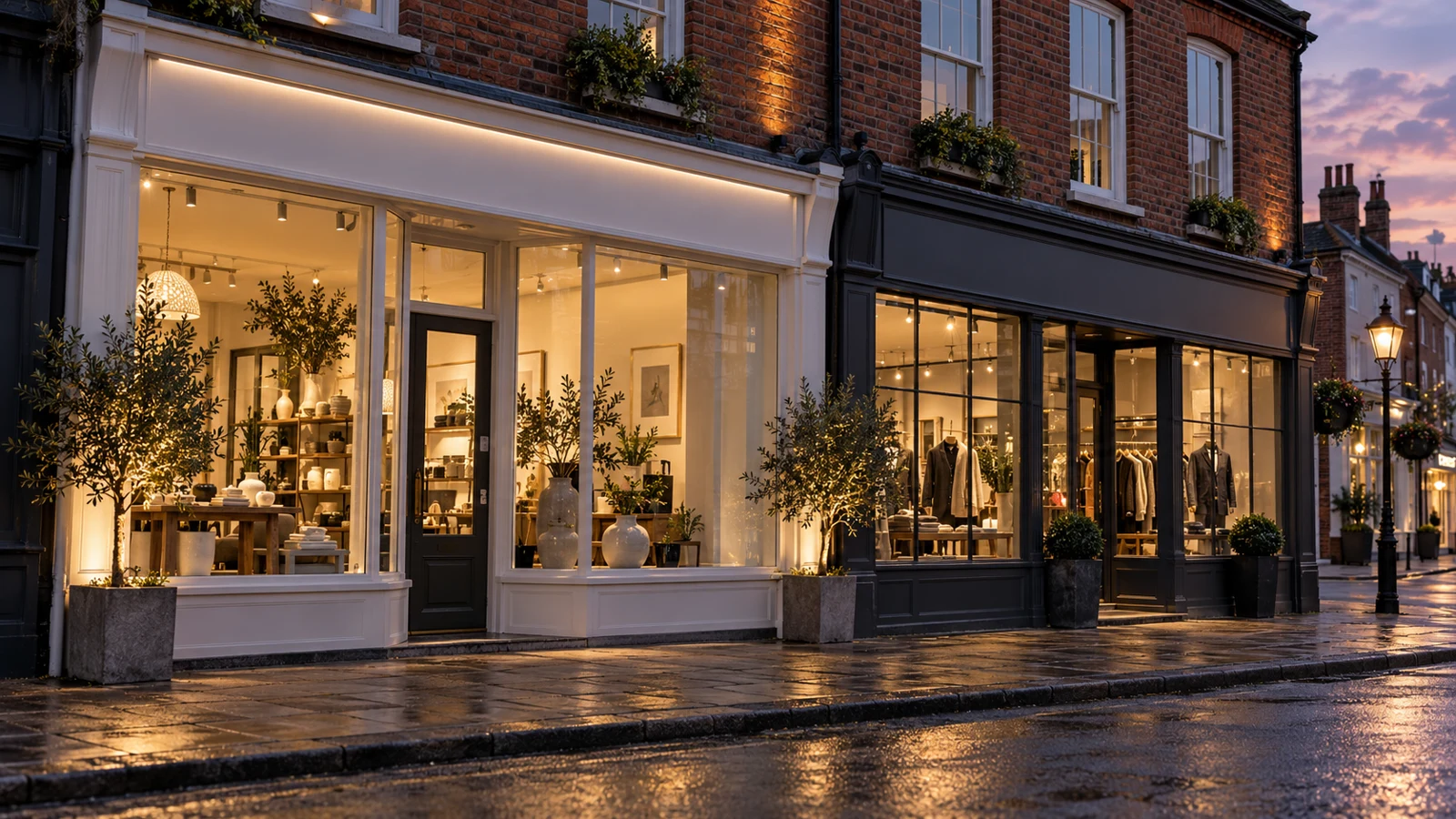
Start with the hours when your sign needs to work.
A shop sign should help customers recognise the business and find the entrance. Whether it needs illumination depends on the setting and trading pattern, not simply on whether lighting looks impressive in a photograph. A daytime showroom on a well-lit parade has a different brief from a restaurant welcoming customers after dark. Consider the approach from both directions and the points at which people make decisions.
Photograph the frontage in daylight and after dark before choosing. Include neighbouring signs, nearby windows and the entrance itself. This helps separate a branding problem from a lighting problem. If the name is too small or visually crowded, adding light may make the same weak layout brighter without making the business easier to identify.
Compare at a glance.
On a smaller screen, scroll across to compare all options.
| Factor | Illuminated sign | Non-illuminated sign |
|---|---|---|
| After-dark identity | Designed light can support recognition | Depends on available ambient light |
| Daytime appearance | Assess materials with lights switched off | Assess colour, shape and depth |
| Installation | Includes lighting and electrical coordination | Primarily fabrication and mounting |
| Maintenance | Access needed for lighting components | Cleaning and fixing checks still needed |
| Operating cost | Depends on power, hours and tariff | No sign-lighting energy requirement |
| Design flexibility | Construction affects fine detail and effects | Printed or cut details offer different options |
| Neighbours | Consider brightness and operating hours | Consider scale, colour and frontage impact |
| Permissions | Check actual lighting and site proposal | Do not assume an automatic exemption |
| Best starting point | Evening recognition or a defined lighting brief | Daytime identity and a simpler sign system |
Illuminated signs: useful visibility with more to coordinate.
Illumination can be incorporated in different ways. Face-lit letters direct light through the letter faces; halo lighting creates an effect behind lettering; external lighting can illuminate a sign face from outside. Fabricated letters can be specified with different illuminated options to suit the design. These approaches should be compared through actual samples and a frontage design.
Lighting is worth exploring when your entrance needs recognition during evening trading, when the surrounding environment is visually busy or when the design calls for a particular night-time identity. The result depends on the letter shape, colour, mounting background and viewing angle. A restrained, readable scheme can be more effective than lighting every graphic element.
The additional considerations include an electrical supply, cable routing, access to equipment and a maintenance plan. Ask where drivers or other components will sit and how they can be reached later. A beautiful initial installation can be inconvenient to service if access is hidden behind permanent finishes. Confirm responsibilities for electrical work before the fit-out schedule is fixed.
Non-illuminated signs: strong branding with a simpler system.
A non-illuminated sign can still have a distinctive, premium appearance. Materials, colour contrast, depth and spacing all contribute. Flat panels, fabricated trays and raised lettering give different design options without requiring lighting within the sign. Daytime businesses may find that a carefully composed non-illuminated fascia meets the brief very well.
The main limit is how the sign will be seen when ambient light falls. Street lighting or nearby shop windows should not be assumed to provide reliable, even illumination of your frontage. If night-time recognition matters, inspect the actual location after dark. Look at the name from the pavement and from the normal customer approach rather than standing directly underneath it.
An unlit sign still needs cleaning, sound fixings and a planned installation. It is not maintenance-free, and choosing it does not automatically remove advertisement-consent questions. Its simpler construction can reduce the number of systems to coordinate, but the mounting surface and the intended appearance remain important parts of the quotation.
Judge the daytime and evening appearance together.
A sign that glows attractively at night also has to represent the business during daylight. Ask how the face materials and returns will look when switched off. Conversely, a dark printed brand colour may behave differently when translated into a translucent illuminated face. Agree how closely the design needs to match other brand applications and review samples where that distinction matters.
Keep lettering legible before adding decorative effects. Fine strokes, tightly spaced characters and complicated symbols can be difficult to translate into some illuminated constructions. A secondary strapline may work better as a simpler element beneath the main name. The aim is a clear hierarchy that suits the frontage, not forcing every part of the logo into the same construction.
Consider neighbouring premises and residential windows. Discuss the intended operating hours, brightness control and switching arrangements from the outset. Avoid specifying a permanently bright display simply because a control decision has been postponed. The selected scheme should be comfortable in its surroundings as well as useful to your customers.
Compare the whole project and its upkeep.
The purchase price alone does not describe an illuminated sign. A complete comparison should identify fabrication, fitting, access equipment, electrical work, any alterations to the frontage and commissioning. Ask whether the quotation includes removing the old sign and making good visible areas. An apparently inexpensive option may exclude work that another supplier has included.
Running cost depends on the installed power requirement, operating hours and your electricity tariff. Ask for the actual specification rather than using a generic estimate for all LED signs. Maintenance costs depend partly on how accessible the installation is. A component above an awkward canopy presents a different service task from one designed with straightforward access.
For both options, ask what is covered by the agreed warranty and what maintenance the owner should arrange. Keep the approved drawing, material details and any electrical documentation. If the business later changes hours, branding or occupancy, those records make it easier to understand what can be retained and what needs redesigning.
Confirm permissions for the actual design.
In England, advertisement control is a separate consent regime. Some signs have deemed consent subject to conditions; others require express consent. Illumination, position and the building context can affect the assessment. A non-illuminated sign is not automatically exempt. Refer to GOV.UK advertisement guidance and check the specific proposal with the local planning authority before manufacture.
Landlord approval is a separate matter, and listed buildings may require additional consent. For a useful initial enquiry, provide dimensions, a frontage photograph and a description of the proposed lighting and hours. Our shop-sign consent guide helps you prepare that information. The final requirements come from the relevant authority and the circumstances of the site.
Examples of when each approach earns its place.
Illustrative example: a restaurant operates into the evening on a street with competing illuminated frontages. A clearly readable illuminated name could help customers locate it, but the solution should be tested against the neighbouring windows and the entrance lighting. Lighting the principal name may be enough; a long list of services need not glow too.
Illustrative example: a daytime interiors showroom has a generous fascia and a strong, simple wordmark. Non-illuminated raised lettering or a well-finished panel could provide the desired identity. The budget may be better spent on proportion, materials and installation than on a lighting system the business does not need during normal customer visits.
Illustrative example: a small professional practice occupies a sensitive frontage. A restrained unlit design might be a useful option to discuss with the landlord and authority. That is a design starting point, not a promise of approval. The building details and proposed fixings still need consideration.
Make the decision with a frontage proposal.
Bring the comparison back to one drawing of your actual premises. Show the sign dimensions, lettering, background, fittings and any lighting locations. Review it at the intended reading distance, then compare what changes between the lit and unlit options. This makes the discussion practical and helps avoid spending on features that do not improve recognition or the customer journey.
Your project checklist.
- Business opening hours and when customers arrive after dark.
- Frontage photographs in daylight and after dark.
- Sign dimensions, mounting height and proposed reading distance.
- Logo files and any important brand colour requirements.
- Known electrical supply, access constraints and fit-out dates.
- Landlord requirements, listed status or existing consent documents.
- Budget for fabrication, installation and ongoing maintenance.
Your questions. Answered.
Are all illuminated signs very bright?
No. Effects vary with construction, material, light output and controls. Discuss the required appearance and the surroundings. Ask to review a relevant sample rather than assuming every illuminated sign will resemble a bright lightbox.
Can lighting be added later?
Sometimes, but it should not be assumed. The structure, materials, electrical provision and permissions may need reconsideration. If future lighting is likely, mention it during the original design so the options can be assessed.
Will an illuminated sign increase enquiries?
It may improve recognition in the right setting, but there is no guaranteed sales result. Good positioning, readable design and an obvious entrance remain essential. Choose lighting to solve a specific visibility need.
Who decides whether consent is needed?
The local planning authority can advise on the actual proposal. Provide dimensions, position and lighting details. Landlord permission and any other site-specific approvals should be addressed separately.
Sources & further reading.
Sources checked for this draft on 18 October 2026. Product ratings apply to the stated product and test conditions; confirm the current specification for your order.
Put the advice into practice.
Tell us where the sign will go, what it needs to communicate and the date you are working towards. Our Norwich team can discuss the design, materials and fitting around your project.
Visit our Norwich workshop ↗ · Find signage for your sector ↗